

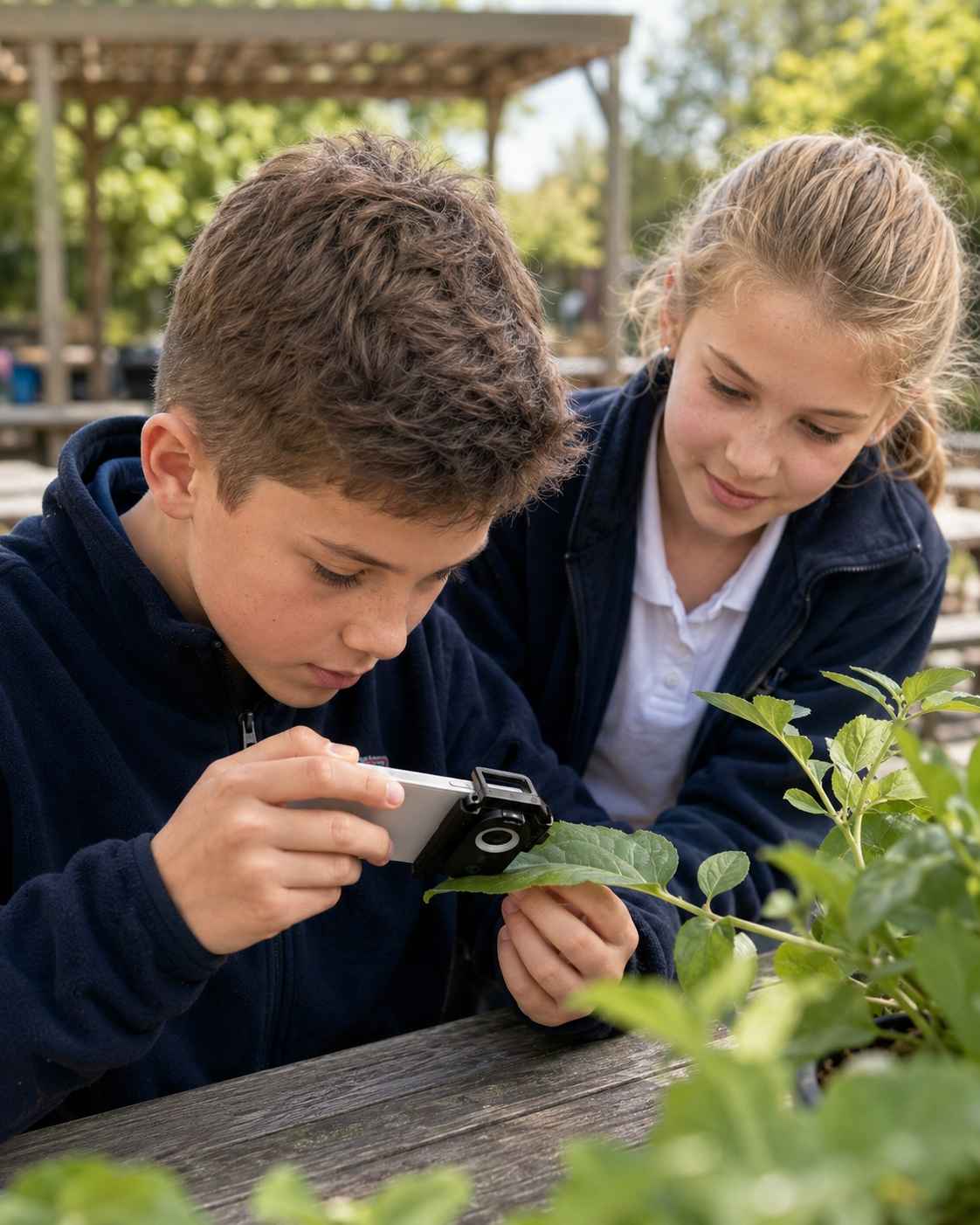
What if your next science discovery were already sitting on your desk, growing outside your window, or hidden within the fabric of your backpack?
With a phone microscope, ordinary objects can appear dramatically different up close. A leaf turns into an intricate network of veins; fabric becomes an intricate web of fibers; even printed paper reveals details that might otherwise go unseen by human eyes.
That makes the APEXEL PhoneMicro 5 an accessible way to start out each new school year. Offering 100X, 150X, 200X and 300X magnification options, you can quickly go from larger surface patterns to finer microscopic details using just your phone.
Here are 9 simple things you should explore this school year, whether you're working on a science project, learning at home, or simply wondering about what might be hidden nearby.
Leaf Veins
A leaf may appear simple from afar, but closer inspection reveals an intricate network of veins and channels.
Launch a regular camera of your smartphone to observe a fresh leaf's surface, taking note of its shape, color and vein structure. You may notice its overall form, hues and any larger veins visible therein.
With a phone microscope, the smaller branching veins and surface textures become much clearer to see.

- Major and minor vein patterns
- Differences between the top and underside of leaves
- Surface texture differences between plants
- Minute hairs on some plants
Lower magnification works well here because it allows you to see enough of the leaf structure at once without zooming too deeply into any one small spot.
Flower Petals
Flowers are captivating subjects for photography, yet their petals become even more fascinating when seen up close.
Under normal camera lighting conditions, phone camera images display only the color and shape of flowers; when magnified they reveal subtle ridges, cells, pollen particles and fine surface details that become evident under magnification.

- Petal texture
- Color variation
- Fine ridges
- Pollen around the center of the flower
Start out at 100X to keep some of the petal structure visible before zooming up if you wish to focus on minute details.
Insect Wings
Under magnification, insects' wings make an intriguing subject to study.
From a distance, wings may appear transparent or colored; up close, however, their intricate networks of veins, repeating patterns, and minute surface structures begin to come into view.

- Wing veins
- Transparent membranes
- Repeating patterns
- Scales or fine textures, depending on the insect species
Utilize lower magnification first in order to get a sense of the overall structure before zooming closer.
Wherever possible, preferring to observe naturally shed wings or already dead insects over disturbing living ones is always preferable.
Fabric Fibers
Your T-shirt, school uniform, backpack and pencil case could all make great microscope samples.
Fabric may appear continuous to the naked eye; but magnification reveals its true composition as individual fibers woven or knitted together.

- Individual threads
- Weaving patterns
- Loose fibers
- Differences between materials
This range provides you with a closer view of individual fibers while making fabric construction simple to understand.
Printed Paper
A printed textbook page looks perfectly smooth from an average viewing distance.
Under magnification, printed letters and images reveal tiny dots, uneven ink edges and fibers making up paper itself.

- Ink dots
- Edges of printed letters
- Paper fibers
- Differences between printed photos and text
Start at 150X for looking at printed characters, then increase magnification if you wish to focus more on ink and paper structures.
Coins
Coins contain many tiny details that may easily go overlooked.
Your phone camera may provide the ability to capture an entire coin, while a microscope allows for closer examination of individual letters, scratches, textures and signs of wear.
Antique coins can be particularly fascinating, with their surfaces often bearing signs of use over the years.

- Scratches
- Raised lettering
- Surface wear
- Small grooves
Coins typically feature relatively large surface features, so the highest magnification may not always be necessary.
Crystals & Minerals
A great way to add a scientific element into an observation is with crystals and minerals.
Salt, sugar and small mineral samples all reveal distinctive shapes when examined more closely.
Your regular phone camera might just see them as random dots or grains; under magnification, their edges and geometric structures become much clearer.

- Crystal shapes
- Sharp edges
- Surface imperfections
- Differences between specific types of crystals
Magnification depends on the size and composition of your sample; start at 100X and work your way closer as necessary.
Everyday Surfaces
For some of the best microscope subjects, everyday surfaces make an excellent subject without collecting anything additional.
Consider looking around your desk or classroom.
Pencils, erasers, painted surfaces, cardboard boxes and plastic objects all may contain minute patterns, scratches and imperfections.
Your eyes may perceive a surface to be perfectly smooth; however, magnified images reveal something entirely different.

- Scratches
- Dust
- Small cracks
- Manufacturing patterns
- Surface textures
Use 100X magnification for larger textures, then increase magnification when you encounter an interesting spot worth closer investigation.
School Science Experiments
An affordable phone microscope can transform classroom materials into topics you can revisit outside the lab.
Depending upon your field of research, samples may include plant material, fibers, crystals or other dry specimens.
Instead of reading about structures in textbooks, why not observe and photograph them directly using your phone?

That depends on the experiment being undertaken.
Before beginning, it's essential that you pose a question:
Examine your sample and compare its result with what you predicted.
Beginning low, locate the area to examine, and increase magnification for finer details.
This simple approach to research can turn casual exploration into an in-depth science project.
Which Magnification Should Be Used?
Higher magnification does not always result in improved results. Magnification choices depend on what it is you wish to examine.
Can help capture larger structures and surface patterns, such as leaf veins, coins, petals and crystals.
Serves as an effective middle ground for textures, fibers, printed materials and smaller plant details.
Can help when focusing on smaller structures such as fibers, insect wing details and surface features.
Is ideal for taking detailed images where a more limited field of view is useful.
Turn Observation Into a Mini Science Project
Start thinking like a scientist without undertaking complex experiments. Choose two items with similar properties and compare them.
Take photos at equal magnification, record what you notice, and compare your observations. An ordinary object can quickly turn into the focus of an investigation.
Your Next Discovery May Be Closer Than You Think
Science doesn't always start in a laboratory environment.
Sometimes all it takes to start something big is one leaf from your backyard, a thread from your backpack, a pinch of salt from the kitchen or an unassuming coin on your desk.
With PhoneMicro 5, your smartphone becomes a handy way to explore any tiny detail your curiosity piques.
No complex setup and no need to wait for the next lab session.
Simply select something ordinary — and take a closer look.
Start Your Back-to-School Discovery
Discover PhoneMicro 5 and other tools for microscopic discovery during APEXEL's Back-to-School Sale.
Start Your Back-to-School Journey →
Share:
Into the Tiny Wild: Macro Photography of Insects & Flowers
Are Phone Camera Lenses Still Worth It in 2026? After the Latest iPhone Camera Upgrades